Blog
Can Hemp Stop Migration from the Hills? How 7 LOIs Could Transform India’s Hemp Industry

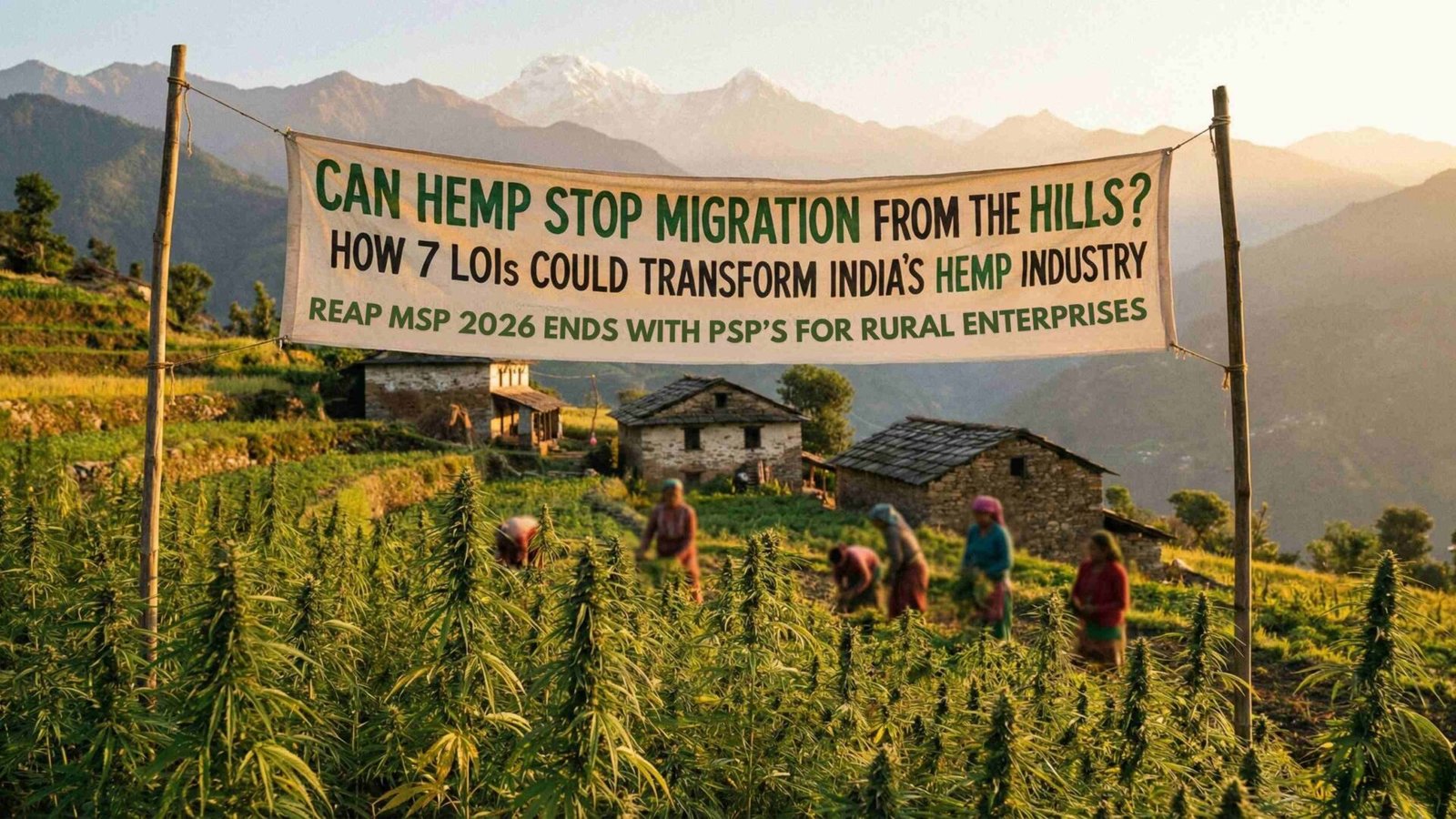
A Defining Moment for Rural Uttarakhand
Migration from the hill districts of Uttarakhand has remained a persistent challenge for decades. Families relocate in search of stable income. Skilled youth move to cities. Consequently, rural economies weaken and local industries struggle to scale.
However, on 10th February 2026, a structured intervention began in Dehradun. At the State Level Multi-Stakeholder Platform under the Rural Enterprise Acceleration Project (REAP), Indian Hempstore signed seven strategic Letters of Intent (LOIs). These agreements aim to build a scalable, market-linked hemp ecosystem across key districts of Uttarakhand. In the esteemed presence of Shri Ganesh Joshi, Minister of Soldier Welfare, Agriculture and Rural Development, Government of Uttarakhand, along with key dignitaries including Jharna Kamthan (Project Director, REAP & Chairman, House of Himalayas), Bhupendra Prasad Kandpal (Director Finance), Naresh Kumar (Deputy Commissioner – Project), and Mahendra Singh Yadav (Deputy Director, UGVS REAP), we participated in one of the most impactful rural enterprise platforms in the state.
REAP MSP 2026: A Platform for Structured Rural Enterprise

The two-day Multi-Stakeholder Platform brought together:
- 30 Private Sector Companies
- 26 Community-Based Organizations (CBOs)
- Representation from 13 Districts of Uttarakhand
The theme, “Partnerships for Rural Enterprises,” emphasized collaboration between rural institutions and private enterprises. Discussions focused on:
- Structured market access
- Strengthening supply chains
- Product quality and packaging
- Scientific processing methods
- Scalable rural enterprise development
Indian Hempstore was among the selected private companies participating in this initiative. The platform enabled direct engagement with district-level institutions and rural production units.
The 7 Organizations Partnering Through LOIs

Indian Hempstore signed seven LOIs with the following organizations:
- Himadri – Handloom and Handicraft Sahakari Samiti Ltd, Almora
- Unnati Cluster Level Federation, Almora
- District Project Management Unit (DPMU), Uttarkashi
- District Project Management Unit (DPMU), Nainital
- District Project Management Unit (DPMU), Chamoli
- District Project Management Unit (DPMU), Bageshwar
- District Project Management Unit (DPMU), Dehradun
This collaboration represents one of the largest single-platform rural hemp partnerships undertaken by a private enterprise in India. Each agreement establishes a district-level framework for training, procurement, production, and structured market linkage.
Implementation Roadmap: From Agreement to Action

These LOIs are designed for measurable outcomes. The implementation roadmap includes:
Skill Development and Capacity Building
- Training over 300 rural women in hemp-based product development
- Introducing scientific fiber extraction and processing techniques
- Strengthening manufacturing quality standards
Structured Raw Material and Supply Chain Development
- Establishing hemp seed sorting and identification systems
- Conducting district-wise raw material mapping
- Setting up decentralized production units in hilly regions
Technology and Market Integration
- Providing AI-based training in content marketing and product design
- Enabling bulk order execution and white-label manufacturing
- Integrating rural producers into a structured B2B and B2C hemp marketplace
This structured approach ensures that value addition takes place within districts rather than outside them.
Why Hemp Holds Strategic Potential for the Hills

Uttarakhand’s terrain and climate are suitable for hemp cultivation. However, cultivation alone cannot address migration. Sustainable impact requires organized value chains, assured procurement, and quality-driven processing.
The LOIs focus on:
- Adoption of best cultivation practices
- Scientific post-harvest processing
- Standardized packaging and branding
- Market readiness aligned with national and global standards
When farmers receive predictable demand, confidence increases. When women-led enterprises generate local income, households stabilize. When youth see viable opportunities within their districts, migration reduces gradually.
From District Clusters to Global Markets
Following the MSP, district-level execution will begin with:
- Geographical feasibility assessments
- Skill gap analysis
- Cluster-based production planning
- Structured training workshops
Through Indian Hempstore’s Hybrid Hemp Marketplace, rural producers gain:
- Access to national buyers
- Opportunities in international markets
- Transparent procurement systems
- Scalable B2B and B2C distribution channels
This integrated ecosystem connects farmers, processors, designers, and buyers within a unified framework.
A Long-Term Vision for Uttarakhand

With institutional backing and coordinated execution, Uttarakhand can evolve into:
- A hemp fiber innovation hub
- A seed processing and oil extraction center
- A sustainable textile and handicraft cluster
- A global supplier of high-quality hemp raw materials
The collaboration between REAP, UGVS, district-level institutions, and private enterprise signals long-term commitment toward structured rural industrialization.
Can Hemp Slow Migration from the Hills?
Hemp is not a standalone solution. However, structured rural enterprise can create sustainable alternatives to migration.
These seven LOIs represent:
- Market-linked rural production
- Institutional accountability
- Skill-driven empowerment
- Organized supply chains
- Scalable economic planning

10th February 2026 marked a transition from dialogue to district-level execution. If implemented with discipline and consistency, these partnerships could redefine India’s hemp industry. More importantly, they could create stable, dignified opportunities within the hills themselves.
When opportunity grows locally, migration naturally declines.